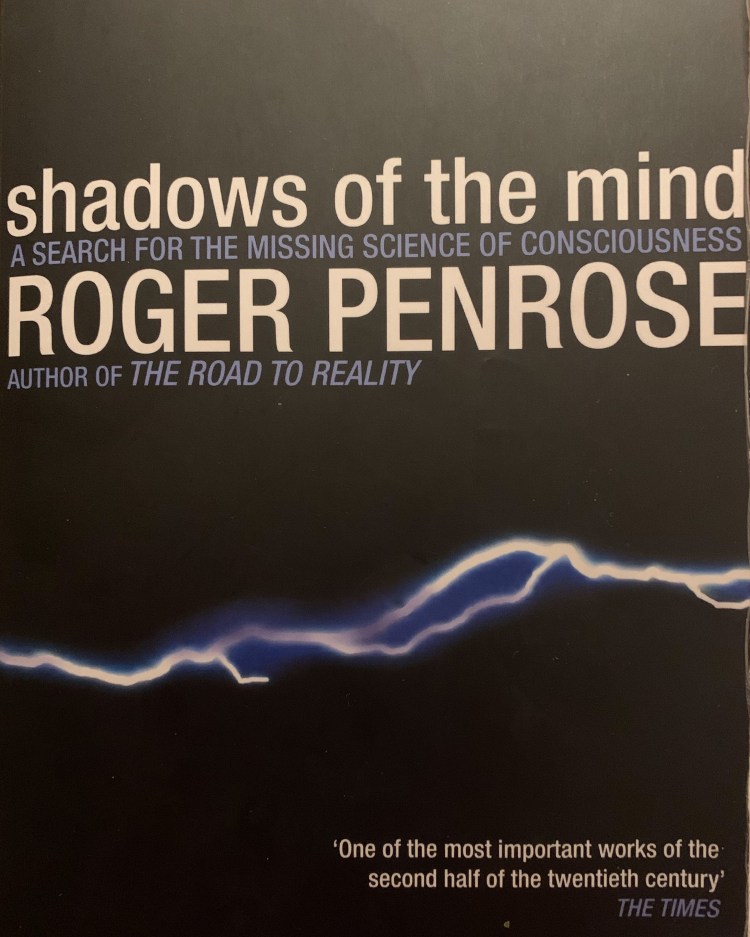
Roger Penrose, Oxford University Press, 1994
By writing this master work, the writer aimed to get to this conclusion: “There are some ingredients in a conscious thinking that can not be simulated by mere computations.” With a special entertaining philosophical language that is rarely seen in science writing, the author takes the reader smoothly through lots of details which could be boring if they have been told by a mere scientific voice. The content of the book is divided, generally, in two parts; The first part aims to answer this question: why we need a new physics to understand the mind. Some matters, mostly mathematical, are brought up in three chapters to show the shortage of the mere computation for understanding all aspects of the mind. Starting with the place of mind in physics, in the second part, he tries to answer this question: what new physics we need to understand the mind. Via a simple explanation of quantum theory, the last chapters lead the reader to the quantum mechanical aspect of the mind. The comprehensible illustration of lots of basic principles in mathematics and physics makes the book a valuable reference, especially for those who are interested in the mystical aspect of these fields of science regarding their connection with the mysterious world of the mind.
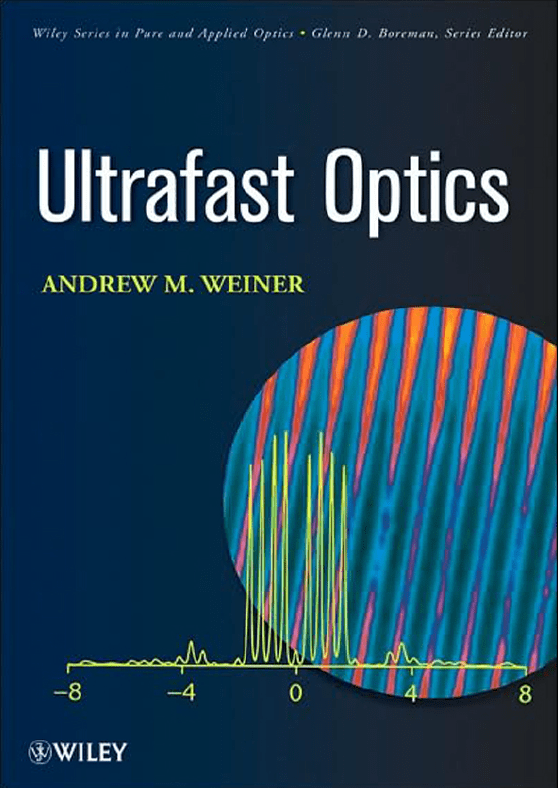
Andrew M. Weiner, Wiley, 2009
The author has written a valuable reference on lasers with ultrashort pulses, primarily at wavelengths in the visible range and longer, with an emphasize on signal aspects. The book starts with basic fundamentals of electromagnetic with regard to single-mode lasers and their essential elements. From this review, the author brings the reader to mode-locked lasers describing different modulators as the extra element of mode-locked lasers comparing with the single-mode lasers. In addition to generating the ultrashort pulses, this agile volume also gives instructions for how to measure ultrashort pulses. The remaining chapters mainly deal with nonlinear ultrashort optics and pulse shape manipulating methods. Additionally, two major applications of ultrashort pulses, namely time-resolved spectroscopy and ultrafast electromagnetic generation and measurement are covered. The fundamental principles with lots of details complemented by mathematical aspects make the book suitable for students of physics, optics, and engineering who aim to build a foundational knowledge about ultrafast optics. The book is also profitable for researchers who closely work with either generation or measurement techniques of ultrashort pulses.
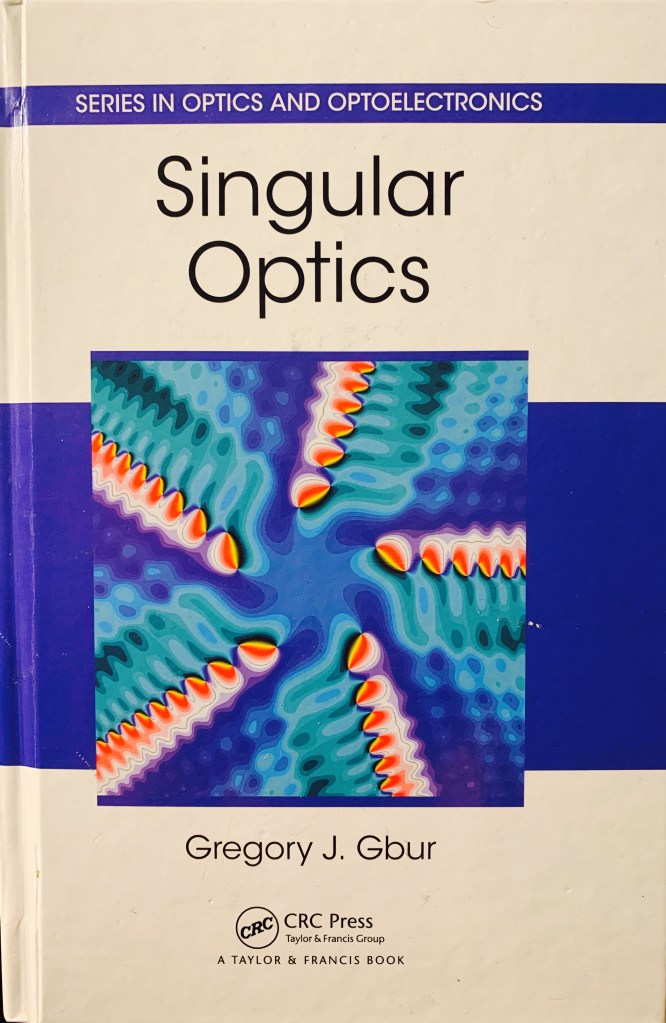
Gregory J. Gbur, CRC Press, 2017
The author has written a comprehensive reference on singular optics. This field, that has a strong impact in several technologies from microscopy and biomedical optics to free-space optical communication as well as signal processing, has been grown during last decades (mostly well-known as optical vortices). Generally, it can be categorized as modern optics. Beyond providing basic fundamentals and introducing various forms of optical singularities, the book brings the reader to the techniques of generating and detecting optical vortices as well as their most significant applications. While the content focuses on singularities within classical optics, one chapter is devoted to the study of vortices in the quantum theory. The mathematical background corresponding to each topic has been provided throughout the chapters. However, a working knowledge of electromagnetic and optical wave is somewhat essential. The book’s target audiences, therefore, are advanced undergraduate and beginning graduate students in physics, optics, but also engineering. Moreover, the vast amount of knowledge on physics and technology of the field, and a rich list of related references make the book a valuable research reference.
 Forms & Functions