As light propagates and interacts with matters, the information it carries are encoded in its three main properties (namely degrees of freedom): Intensity, Phase, and Polarization. Shaping light by structuring and manipulating these properties makes it possible to control the light-matter interaction. Consequently, structured light has made a wide range of possibilities in various applications.
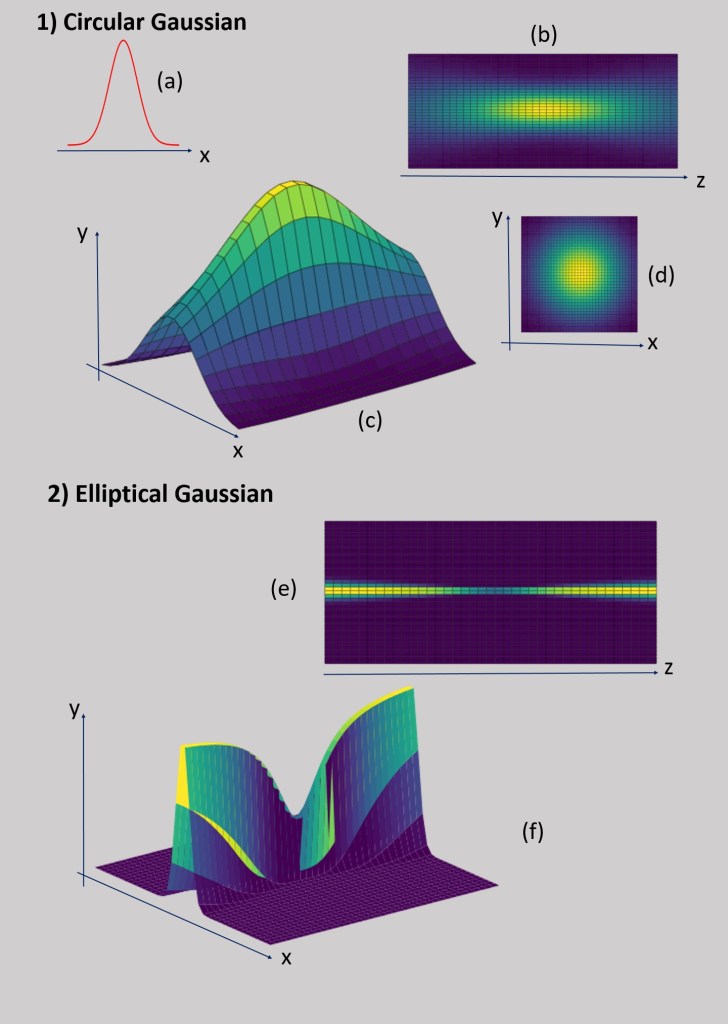
The most common-used and well-known form of light is the Gaussian beam (figure 1a), determined by the geometry of the optical resonator for the laser. Having a circular cross-section, when a Gaussian beam is focused on a sample, it does not propagate with the same radius (intensity) along the propagation axis (see figure 1b). As it can be also clearly seen in the 3D-structure of the beam propagation (figure 1c), the intensity has a maximum value at the focusing point (beam waist). With this circular Gaussian beam, a large area of the sample can be illuminated, as referred to as “wide-field” in microscopy. For sensitive imaging applications especially in biomedicine, however, a sectioning (or selective) form of illumination is needed to decrease the risk of photodamaging. Illuminating the sample with a focused Elliptical Gaussian beam, instead of circular Gaussian, generates an especially thin illumination slice inside the sample (figure 2e-f) known as “light sheet”.
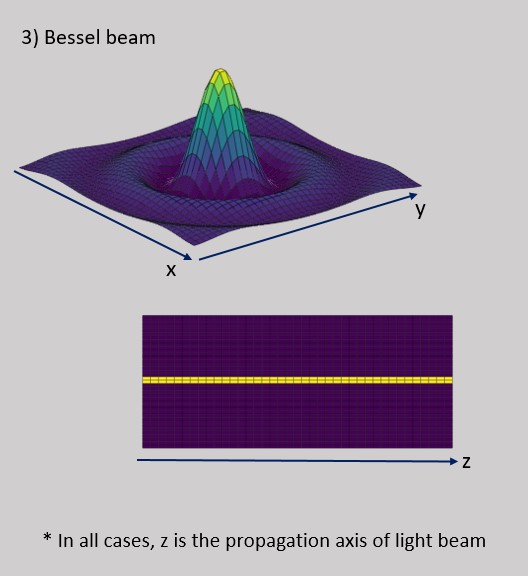
While microscopy with a light sheet preserves the sample under low irradiation levels, it still suffers from diffraction; Compare the area around the center of illumination in figure 2e with the illuminated area far from the center. For imaging large samples such diffraction can be problematic. Using an intensity profile in a Bessel form (figure 3g) as illumination beam produces a non-diffractive propagation inside the sample over a large distance (figure 3h). These are few examples of various functionalities of different shapes of light intensity with the capability of overcoming challenges in microscopy such as limited resolution, and difficulty of looking deep into a sample.
 Forms & Functions